
It’s Not a Matter of If, It’s a Matter of When: Business Cybersecurity Training to Prepare for the Inevitable Cyberattack

If you run a business or manage its technology, you have probably already asked yourself the uncomfortable question: what happens when we get hit?
Not if. When.
The organizations that weather a breach are not the ones with perfect luck. They are the ones that built defenses, used business cybersecurity training, and had a plan ready before the alarm went off. This post is for business owners, IT and security managers, and professionals who want the skills to defend an organization instead of reacting to disaster.
Why “when” is the honest way to think about it
For years, cybersecurity marketing leaned on fear. Today the numbers do the talking, and they are blunt. Ransomware, phishing, and business email compromise have turned into a constant background hum for companies of every size. The pace is relentless, and attackers no longer need a reason to single you out. Automated tools scan the entire internet looking for a weak door, and eventually they knock on yours.
Here is what the current data shows:
- The global average cost of a data breach reached 4.44 million dollars in 2025, according to IBM’s Cost of a Data Breach Report, and the average United States breach climbed to 10.22 million dollars.
- Roughly 43 percent of cyberattacks target small businesses, largely because attackers expect weaker defenses.
- A majority of small businesses report experiencing a breach within the past year, and the overwhelming share of those incidents involve ransomware.
The takeaway is simple. Size is not protection. In many cases it is the opposite, because a smaller company often lacks a dedicated security team while holding data and money worth stealing.
What “getting hit” actually looks like
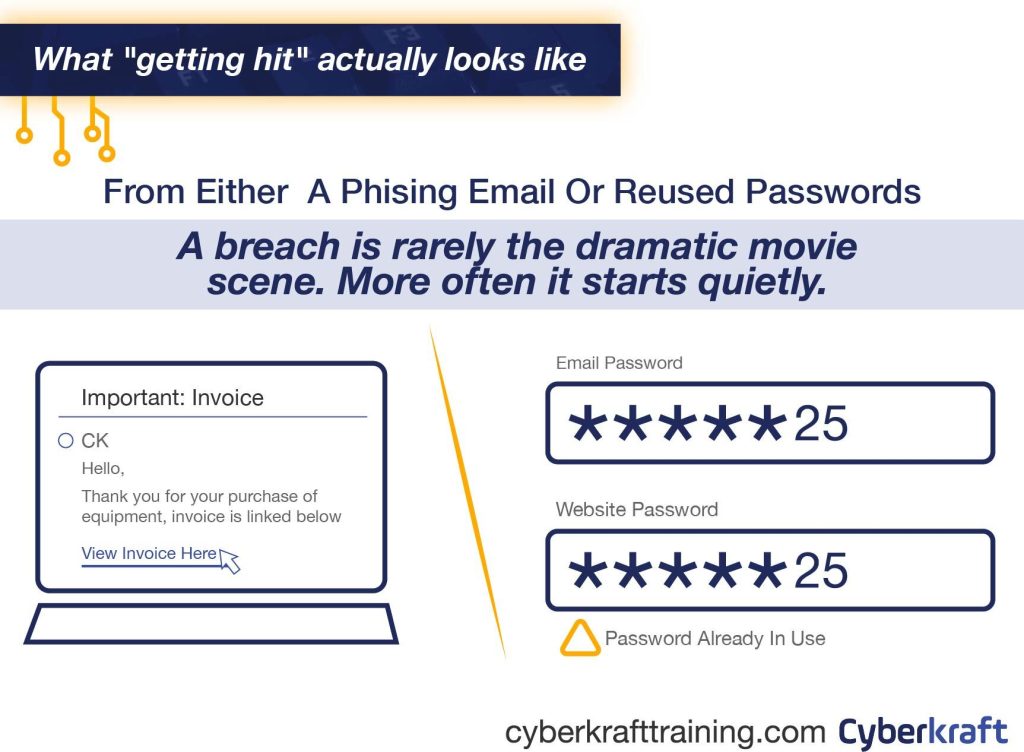
A breach is rarely the dramatic movie scene. More often it starts quietly. An employee clicks a convincing invoice. A reused password shows up in a leaked credential dump. A server that missed a patch gets scanned and exploited within hours. From there the damage compounds.
The costs go far beyond the ransom demand or the immediate cleanup. You are looking at downtime while systems are offline, lost revenue, legal and regulatory exposure, notification requirements, higher insurance premiums, and the slow erosion of customer trust that can outlast every other expense. For a business operating on thin margins, any one of those can be the item that tips the balance.
Understanding the attacker mindset is the first real defense. When your team knows how intrusions actually unfold, they stop treating security as a checkbox and start treating it as a daily practice.
Preparation is a people problem before it is a technology problem
You can buy the best firewall on the market and still get breached on a Tuesday afternoon because someone approved a fraudulent wire transfer. Tools matter, but tools do not investigate an alert at 2 a.m., tune a detection rule, or recognize a spear phishing email that slipped past the filter.
People do that. Trained, certified people.
That is where the real gap sits. The global cybersecurity workforce shortage has been measured in the millions of unfilled roles for years running, with the ISC2 Cybersecurity Workforce Study reporting a gap in the range of several million professionals worldwide. Demand for skilled defenders continues to outstrip supply, which means two things for you: First, hiring seasoned talent is expensive and slow. Second, building those skills inside your existing team is often the faster and more durable move.
Here at Cyberkraft, that is exactly the problem we were built to solve. We are a veteran owned small business, and our instructors come from real world backgrounds across the DoW, VA, DHS, and Army. We do not teach security as theory. We teach it the way it gets used on the job, because that is where we come from.
If you are responsible for a whole team rather than a single certification, start with our enterprise and corporate training page to learn about business cybersecurity training. It is designed for organizations that want to upskill staff in a structured, measurable way instead of hoping individual employees figure it out on their own.
The top certifications that actually build a defensive team
There is no single magic credential that makes a business secure. A capable security function is layered, and the certifications below map cleanly onto the roles you need. Think of it as building a bench, not filling one seat.
Start with the foundation: CompTIA Security+
CompTIA Security+ is the baseline for a reason. It validates the core knowledge every defender needs: threats and attacks, risk management, cryptography, identity and access, and incident response fundamentals. It is vendor neutral, widely recognized by employers, and often the first credential a hiring manager looks for on an entry level security resume.
For a business, Security+ is the common language. When your help desk staff, sysadmins, and junior analysts all hold it, security conversations get faster and mistakes get rarer. Our CompTIA Security+ course covers the full SY0-701 objectives, and for teams that need results on a deadline, our accelerated CompTIA Security+ bootcamp gets people exam ready fast. When your people are prepared to test, you can pick up the Security+ SY0-701 exam voucher and lock in the cost up front.
Detect and respond: CompTIA CySA+
Prevention fails eventually. What separates a minor incident from a headline is how fast you detect and contain it, and IBM’s own research ties faster containment directly to lower breach costs. That is the job of a security operations analyst, and CySA+ is built for it.
CySA+ focuses on behavioral analytics, threat detection, log analysis, and incident response: the hands on skills a SOC relies on every day. If you want people who can read the signals and act before an intrusion spreads, this is the credential. Our CompTIA CySA+ course and the intensive CySA+ bootcamp both prepare analysts for the CS0-004 exam, and you can secure the CySA+ CS0-004 exam voucher when they are ready to sit for it.
Think like the attacker: CompTIA PenTest+ and EC-Council CEH
You cannot defend against an attack you do not understand. Offensive security training flips the perspective, teaching your team to find and exploit weaknesses before a criminal does. That knowledge feeds straight back into stronger defenses, smarter patching priorities, and more realistic risk decisions.
Two paths lead here. CompTIA PenTest+ is a strong, vendor neutral option for penetration testing and vulnerability assessment, and our PenTest+ bootcamp builds those skills in a structured program. The EC-Council Certified Ethical Hacker credential is widely requested in job postings and approved on many government and DoW role lists. Our EC-Council CEH bootcamp gives your team the ethical hacking toolkit and the certification that proves it.
Building the plan: a practical starting point for business cybersecurity training
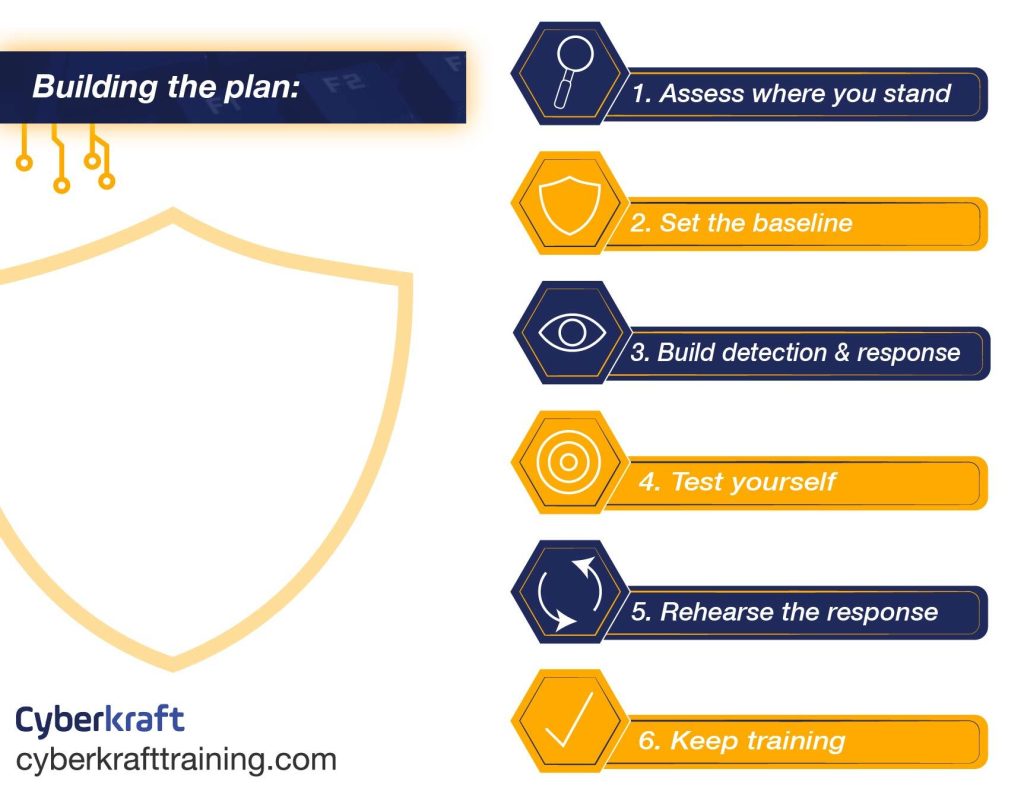
You do not need to do everything at once. You need to start, and to start in the right order. Here is a straightforward sequence any business can follow.
1. Assess where you stand. Identify your critical data, your exposed systems, and the skills your team already has. You cannot protect what you have not mapped.
2. Set the baseline. Get core staff through Security+ so everyone shares the same fundamentals and speaks the same language.
3. Build detection and response. Develop or hire SOC capability with CySA+ trained analysts who can watch the environment and act quickly.
4. Test yourself. Use penetration testing skills, whether in house or trained up through PenTest+ or CEH, to find your own gaps before an attacker does.
5. Rehearse the response. Write an incident response plan, then practice it. The worst time to learn your plan does not work is during a live breach.
6. Keep training. Threats evolve constantly, so treat skills development as ongoing rather than a one time purchase.
The goal is not perfection, which does not exist in security. The goal is resilience: the ability to detect quickly, contain fast, recover cleanly, and keep operating.
Why train with Cyberkraft
Plenty of providers sell courses. Fewer build defenders.
Our programs are led by instructors with genuine field experience, structured around the certifications employers and government agencies actually recognize, and delivered with transparent pricing so you know exactly what you are paying for. For businesses, that means you can turn existing employees into a certified, job ready security team without waiting on a hiring market that never has enough talent.
If cost is a concern, it usually should be weighed against the alternative. Training a team member through a certification is a fraction of the average breach cost, and it is an investment that keeps paying off long after the exam. We also offer flexible financing to make building your team more manageable.
The bottom line
The attack is coming. That is not pessimism, it is planning. The businesses that come through a breach with their reputation and revenue intact are the ones that decided, well before the incident, to invest in defenses and in the people who run them. You can wait and hope, or you can prepare and know.
Ready to build a security team that is ready for what is coming? Explore our enterprise and corporate training options or reach out to our team to map out a training plan that fits your organization. The best time to prepare was yesterday. The next best time is now.