

Is the CompTIA Security+ Worth Getting in 2026?


If you’re weighing whether the CompTIA Security+ is worth your time and money in 2026, you’re asking the right question. A certification is an investment of study hours, exam fees, and focus, and you deserve to know what you get back before you commit. So, let’s skip the hype and look at what Security+ actually does for your skills, your job prospects, and your paycheck.
Here’s the short answer: for most people breaking into cybersecurity or locking in a government or defense role, Security+ remains one of the highest ROI credentials you can earn. Below, we’ll break down exactly why, what the exam covers, who should take it, how to pass it the first time, and how to pay for it.
What the Security+ actually proves
The current version of the exam is SY0 701, which launched on November 7, 2023 and runs through its retirement in May 2027. That means if you certify in 2026, your credential is built on the current objectives, with no scrambling to a new version mid-study.
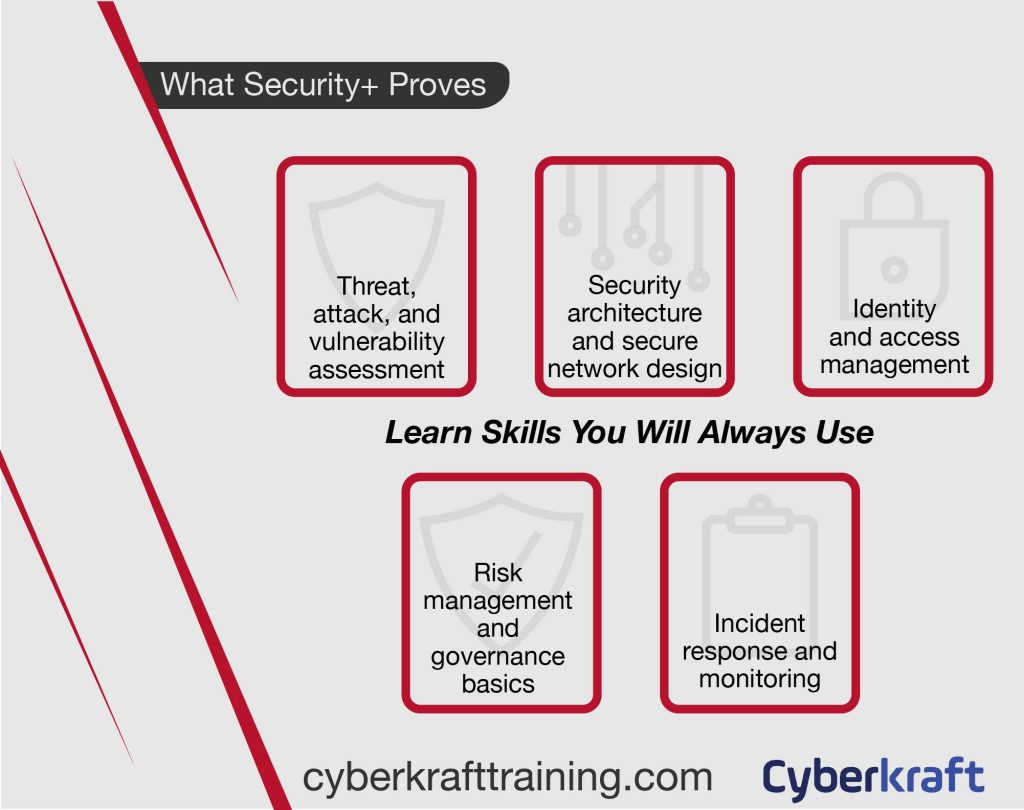
Security+ is vendor-neutral, so it validates skills you’ll use no matter whose tools your employer runs. At a high level, it confirms you can:
• Assess the security posture of an enterprise environment
• Identify, analyze, and respond to threats, attacks, and vulnerabilities
• Design and implement secure architecture and network solutions
• Operate with an awareness of governance, risk, and compliance
• Support incident response, monitoring, and automation
It’s an entry to intermediate level certification, which is exactly why it works so well as a career on-ramp. You don’t need years of experience to pass, but the material maps directly to what a working security analyst does day to day.
Inside the exam: the five domains
The SY0-701 exam is up to 90 questions in 90 minutes, scored on a 100 to 900 scale with 750 required to pass. It includes performance-based questions that ask you to solve problems in simulated environments, not just recognize definitions. Understanding how the exam is weighted helps you study smart. According to CompTIA’s published objectives, the five domains break down like this:
• General Security Concepts (12%): the vocabulary and foundations, including controls, cryptography basics, and the principles behind good security design.
• Threats, Vulnerabilities, and Mitigations (22%): attack types, threat actors, and how to reduce your exposure.
• Security Architecture (18%): building secure networks, applications, and cloud environments.
• Security Operations (28%): the largest domain, covering monitoring, identity and access management, hardening, and incident response.
• Security Program Management and Oversight (20%): governance, risk management, third-party considerations, and compliance.
Notice that Security Operations alone is more than a quarter of the exam. If your study time is limited, that is where the most points live.
Who should take Security+ ?
Security+ is designed for early-career security professionals, but it fits a wide range of people:
• Career changers moving into IT security from another field
• Help desk and support technicians ready to specialize
• System and network administrators who want to formalize their security knowledge
• Military members and veterans targeting cleared cybersecurity roles
• Anyone who needs a DoD 8140 compliant credential for a government or contractor position
CompTIA recommends, but does not require, that you already hold the CompTIA Network+ certification and have a couple of years of IT administration experience with a security focus. That foundation matters. A lot of the Security+ material assumes you understand how networks move data, so if your networking fundamentals are shaky, starting with Network+ will make Security+ far easier to absorb.
The job market in 2026
Demand is not slowing down. Security+ is the most widely held entry-level cybersecurity certification in the world, with more than 700,000 professionals certified. The U.S. Bureau of Labor Statistics projects information security analyst roles to grow 29% from 2024 to 2034, dramatically faster than the average occupation.
Roles that commonly list Security+ include:
• Security analyst and SOC analyst
• Systems administrator with security duties
• Network security specialist
• IT auditor and compliance roles
• Junior penetration tester, as a stepping stone
There’s also a factor a lot of guides overlook: Security+ is DoD 8140 compliant. If you want to work for the Department of Defense or a defense contractor, this certification isn’t just a nice-to-have; it’s frequently a requirement to hold the job at all. For veterans and transitioning service members, that makes it one of the most direct paths into a cleared cybersecurity career.
Let’s talk ROI
This is where the math gets convincing. According to the U.S. Bureau of Labor Statistics, the median annual wage for information security analysts was $124,910 (May 2024 data). Entry-level roles that Security+ opens typically start lower, but CompTIA’s own research finds that certified professionals earn meaningfully more than non-certified peers in comparable roles.
Now weigh that against the cost. The SY0-701 exam runs in the neighborhood of $425 but if you purchase from Cyberkraft you can get a discounted voucher for just $365. Even a modest salary bump in your first certified role pays that back many times over in the first month on the job, before you even factor in the roles you simply couldn’t apply for without it.
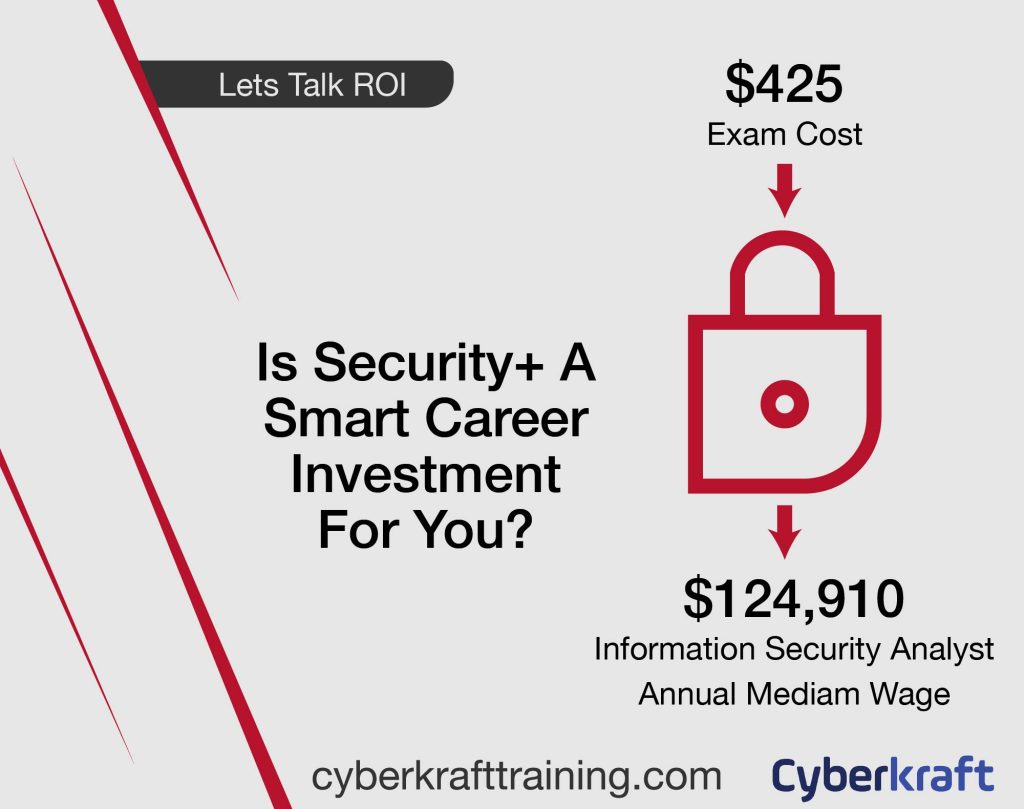
The takeaway: the barrier to entry is low, and the career doors it opens are wide. That’s the definition of a strong ROI.
How Security+ fits into your bigger certification path
Security+ is rarely the finish line. It’s the credential that unlocks the next set of opportunities. A common progression looks like this:
1. CompTIA Network+ to build the networking foundation.
2. CompTIA Security+ to prove core security skills and satisfy DoD 8140.
3. CompTIA CySA+ to move into threat detection and security analytics.
4. CompTIA PenTest+ if offensive security and penetration testing appeal to you.
Thinking about the whole path early helps you choose training that builds on itself instead of starting from scratch each time.
How long does it take to study?
There’s no single answer, because it depends on your starting point. As a realistic guideline:
• With solid IT and networking experience: four to six weeks of focused study.
• Newer to the field: eight to twelve weeks, especially if you’re learning networking concepts alongside security.
Consistency beats cramming. A steady hour or two a day, paired with hands-on practice and practice questions, is far more effective than occasional marathon sessions. Give yourself extra time on the two heaviest domains, Security Operations and Threats, Vulnerabilities, and Mitigations.
How to pass it the first time
Performance-based questions are where a lot of self-studiers stumble, because you can’t fake hands-on skill with memorization. Passing on the first attempt comes down to structured preparation, real practice, and knowing what to expect on exam day.
That’s exactly what we build our training around. Our self-paced CompTIA Security+ course walks you through every exam objective at your own speed, while our live CompTIA Security+ bootcamp gives you instructor-led, exam-focused prep with real-world context from a team that has trained professionals across the U.S. Army, DoD, VA, and DHS.
And when you’re ready to sit the exam, you can pick up your CompTIA Security+ (SY0-701) exam voucher right from us, so the whole path from study to certified is in one place.
Paying for it: funding options
Cost should not be the reason you put off certifying. Depending on your situation, you may have several ways to cover training and exam fees:
• Military and veteran funding. Programs like AF COOL and other service-branch benefits can cover certification training for eligible members. Our military training programs are built specifically to help service members and veterans use those benefits.
• Flexible financing. If you’re paying out of pocket, our financing options let you spread the cost over time instead of paying everything upfront.
• Employer sponsorship. Many organizations have professional development budgets. It’s worth asking, because employers benefit directly when their teams are certified.
If you’re not sure which option fits, reach out to our team and we’ll help you figure out the most affordable path.
Keeping your certification current
Security+ is valid for three years. To keep it active, you can complete CompTIA’s continuing education program by earning 50 Continuing Education Units (CEUs) over the three-year cycle, or you can pass a higher-level certification, which renews Security+ automatically. There’s a modest annual maintenance fee to stay enrolled in the continuing education program. Planning your next certification during those three years is often the smartest move, because it advances your career and renews Security+ at the same time.
Frequently asked questions
Is Security+ hard?
It’s challenging but achievable, especially with structured preparation. The performance-based questions reward hands-on practice, so the more you work in real or simulated environments, the more comfortable you’ll be.
Do I need experience before taking it?
No, but it helps. CompTIA recommends Network+ and about two years of security-focused IT experience. Plenty of motivated beginners pass with good training and consistent study.
Is Security+ still respected by employers?
Yes. It’s one of the most requested cybersecurity certifications in job postings, and it remains a baseline requirement for many government and defense roles thanks to DoD 8140 compliance.
What comes after Security+?
Common next steps include CySA+ for security analytics and PenTest+ for offensive security, depending on the direction you want your career to take.
The bottom line
Is the CompTIA Security+ worth it in 2026? For anyone entering cybersecurity, moving into a DoD or contractor role, or looking to prove baseline security skills to an employer, the answer is yes. The exam is affordable, the demand is real and growing, and the salary upside dwarfs the cost.
If you’re ready to get started, take a look at our Security+ training options and let’s get you certified. Have questions about funding or which format fits your goals? Reach out to our team. We’re here to help you make the smart move for your career.

Responses