
Using the SF 182 to Fund IT, Project Management, and Cybersecurity Training

For U.S. Federal civilians, cybersecurity training funding is often available but underused. In many cases, the barrier is not the budget, but uncertainty about how to access it. The SF 182 training form is the standard mechanism agencies use to approve and pay for employee training, including IT, project management, and cybersecurity programs.
When used correctly, the SF 182 allows your agency to pay directly for certification-focused programs offered by providers such as Cyberkraft, without requiring you to pay upfront or seek reimbursement later.
What the SF 182 Is and Who Uses It
The SF 182, officially titled Authorisation, Agreement, and Certification of Training, is the standard form that Federal agencies use to document, approve, and fund employee training expenses.
As a Federal civilian, you start and complete the SF 182 training form. You identify the training you want to attend, provide your information and the other required details, outline the associated costs, and submit the form through your agency’s internal approval process. Supervisors and training or budget officials then review the request and authorize the cybersecurity training funding.
Even though your agency authorizes the training and processes payment, the process begins with you and without an approved SF 182, agencies generally cannot release payment to external training providers.
What Types of Training the SF 182 Can Pay For
The SF 182 applies specifically to training-related costs. To be eligible, the training must help you build technical skills, strengthen compliance or operational readiness, and support your job performance.
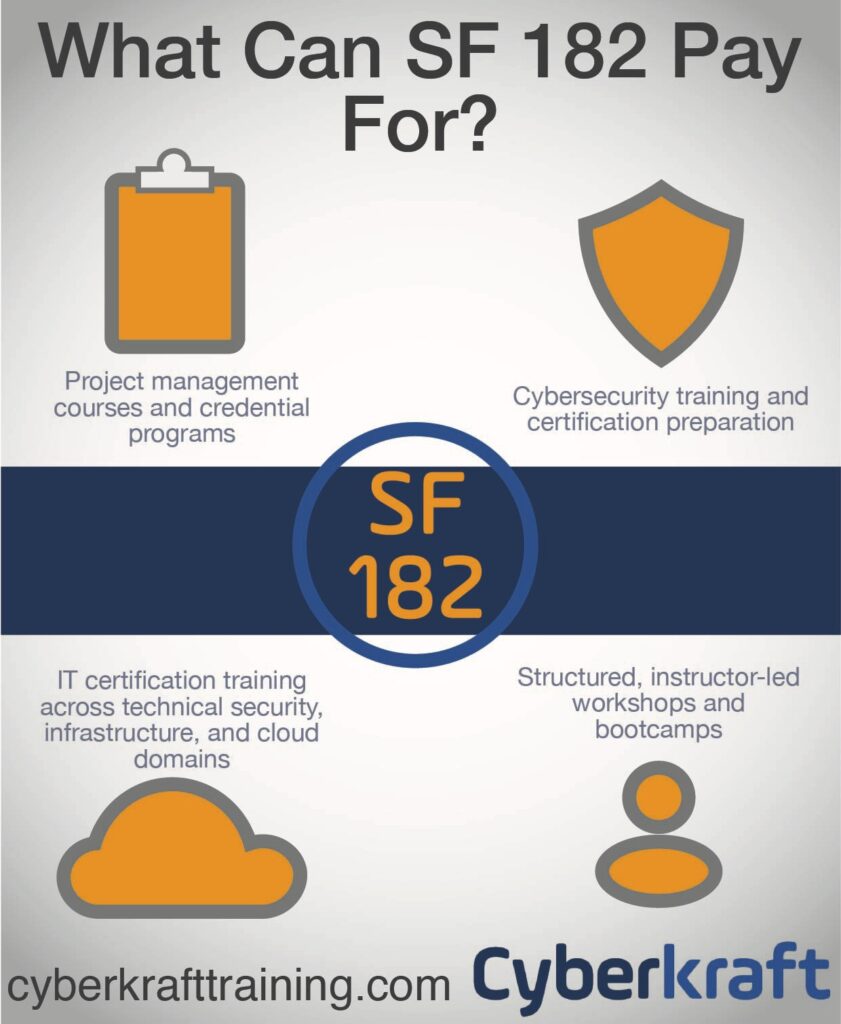
- Cybersecurity training and certification preparation
- IT certification training across technical security, infrastructure, and cloud domains
- Project management courses and credential programs
- Structured, instructor-led workshops and bootcamps
Providers such as Cyberkraft offer training that fits these criteria. Their IT, project management, and cybersecurity programs are structured and clearly documented in a way that makes them suitable for inclusion in an SF 182 request.
How the SF 182 Process Works from Request to Payment
The SF 182 follows a predictable flow, even though submission systems (paper or electronic) may vary by agency.
You start by filling in your employee and organizational details. This connects the training request directly to your role and department and explains why the training is being requested in the first place.
Next, add the training details like the course name, dates, delivery format, and training provider. Selecting a provider like Cyberkraft makes it clear who is delivering the tr aining and what program your agency is being asked to approve.
You then document the training costs, such as tuition and required materials. The cost details you enter must align with the provider’s pricing documentation, as they are used to allocate federal employee training funds. If the details on your SF 182 training form don’t match the training quote, approval can slow down quickly.
Once your form is complete, it moves through your agency’s approval chain. Supervisors review the relevance of the training to your role, while training or budget officials confirm the availability of cybersecurity training funding and its compliance with internal policies.
A key requirement across all agencies is that the SF 182 must be approved before training begins. Agencies cannot retroactively authorize payment for training that has already started. After approval, your agency pays the training provider directly.
Common Approval Issues and How to Avoid Them
Most SF 182 delays happen because of the procedural gaps rather than a lack of eligibility.
One of the most common issues is incomplete or inconsistent cost information. The amounts listed on the SF 182 training form must match the training provider’s documentation exactly. If the tuition, materials, or delivery format aren’t clearly documented, your training office will probably send the SF 182 back so you can fix it before it is approved.
Many agencies require more than just your supervisor’s signature, especially for higher-cost or certification-focused programs. Submitting your SF 182 too close to the training start date will leave reviewers with less time to process it, causing delays or even a denial.
Your request also moves more smoothly if you can clearly explain why the training matters for your role. For example, it might help you meet compliance requirements, manage technical responsibilities, or support your agency’s objectives. Simply listing a course title rarely provides enough context and often leads to follow-up questions that slow the process
Internal policy constraints can affect approval as the agencies may have annual training spending limits, fiscal year deadlines, or restrictions on certain types of training. These rules vary by organization and may not be visible on the form itself. So, it is important to make sure your request follows your agency’s current policies.
Missing approvals or incorrect routing can also delay the processing of your request. Each agency has a defined approval chain, and skipping a required reviewer can stall the request. Check the approval path before submitting your request, as it will reduce administrative back-and-forth.
Using Cyberkraft Within the SF 182 Framework
When requesting agency-funded training, your choice of provider matters. Selecting training providers like Cyberkraft, that have courses with clear descriptions, documented costs, and measurable learning outcomes, makes your request easier for supervisors and training officials to evaluate.
Each program is aligned with the recognized certifications and measurable learning outcomes, making it easy to complete the SF 182 training form accurately. This also gives approving officials the information they need to review your request efficiently and confidently.
A Direct Path to Funded Training Using the SF 182
Federal agencies set aside federal employee training funding each year to support employee development, and the SF 182 training form is the way those funds can be accessed.
If you are planning IT, project management, or cybersecurity training, identify the training that supports your role, submit your SF 182 through your agency’s approval process to authorize and pay for approved programs without personal expense.
Working with a structured provider like Cyberkraft helps keep the request clear, compliant, and straightforward for your agency to review, so the funding process stays on track.