

ISACA CRISC Certification: The Certification That Moves You Closer to Risk Leadership Roles

Cybersecurity is changing, and so are the expectations placed on people working in the field. It’s no longer enough to secure systems or respond to threats. Today, organizations want someone who can explain the real impact of a risk on the business. Someone who can answer questions like: How bad could this be? What’s the financial impact? Which risks need attention first, and why?
As the gap between technical execution and strategic decision-making is widening, the people who can bridge it are moving into higher-visibility, higher-trust roles. If you’re already in cybersecurity, you might have noticed this shift in leadership, with clearer reporting, more compliance conversations, and job postings increasingly requiring governance, risk, and compliance expertise rather than just technical skills.
The ISACA CRISC certification is how you show your employers that you’re familiar with cybersecurity and understand how to evaluate, communicate, and manage risk in a way leadership can act on. So, if you’ve been thinking about how to move from hands-on tasks to leadership-aligned responsibilities, ISACA’s CRISC is a credential worth paying attention to.
What is ISACA CRISC Certification
ISACA, a global authority on governance, cybersecurity, and IT audit standards used across industries, offers the CRISC (Certified in Risk and Information Systems Control) certification. The certification focuses on four core domains:
- Governance
- IT Risk Assessment
- Risk Response and Reporting
- Information Systems Controls
You can sit for the CRISC exam before meeting experience requirements, but you’ll need at least three years of relevant work experience to earn the official CRISC credential. That requirement makes sure that CRISC-certified people can apply risk concepts in real environments.
Some candidates compare CRISC to certifications like CISSP or CISM, but they serve different purposes. CISSP builds broad cybersecurity architecture competence, and CISM focuses on security program leadership. CRISC zeroes in on cyber risk, business alignment, governance, and decision-making, making it ideal for you to influence executive-level planning and work in compliance-driven industries.
Importance of CRISC Certification for Your Career
These days, cybersecurity is more than a technical issue. Organizations face rising regulations, audits, and stakeholder expectations. They no longer treat cybersecurity as a box to tick and need people who can talk about risk in business terms. CRISC equips you to do that.
With CRISC, you move beyond alerts and severity ratings. You communicate the likelihood, cost, operational impact, and regulatory consequences of risks. This skill is what gets you invited to boardrooms and leadership discussions, where decisions are made based on business impact, not just technical severity.
CRISC lets you translate technical vulnerabilities and potential threats into business impact, helping you prioritize risk based on what matters, and design control frameworks that support strategic goals. This shift from reactive security execution to proactive risk governance lifts your professional profile.
Earning CRISC sends a clear signal: you’re not just a “techie.” As a risk specialist, you are aware of the connections between technology, governance, business operations, and compliance. You become a valued asset in areas including banking/finance, healthcare, government, consulting, and corporate IT, where navigating regulations, data protection, audit compliance, and stakeholder trust is critical.
You can take Cyberkraft’s ISACA CRISC course which helps you move from being “the person who fixes things” to “the person who guides what gets built,” which is often the difference between an operational job and a strategic, leadership-level role.
Benefits of CRISC Certification for Individuals
When you earn the CRISC certification, you’re signaling that you understand cybersecurity from a business and risk perspective. That distinction opens doors to roles where decision-making, prioritization, and leadership matter more than technical execution.
You future-proof your career by building skills that outlast any single tool or technology. Cybersecurity technology changes fast, but knowing how to assess risk and guide decisions keeps your skills relevant, regardless of shifting tools or trends.
That foundation naturally opens doors to higher-trust roles. When you earn credibility and can explain technical threats in business terms, your input becomes essential. CRISC validates your ability to make informed, real-world decisions.
From there, it’s easier to step into leadership. Many CRISC-certified professionals find themselves moving from hands-on roles to strategic ones. Security engineers become IT risk analysts, analysts grow into risk managers or governance leads, and technical specialists turn into trusted advisors. CRISC bridges operational expertise and strategic insight, making these transitions visible and valued by hiring managers.
It often comes with a financial upside, too. Roles focused on governance, compliance, and risk strategy typically carry more influence and reward because they shape investment choices, regulatory posture, and organizational resilience. CRISC positions you for both recognition and financial growth.
Career Opportunities After CRISC
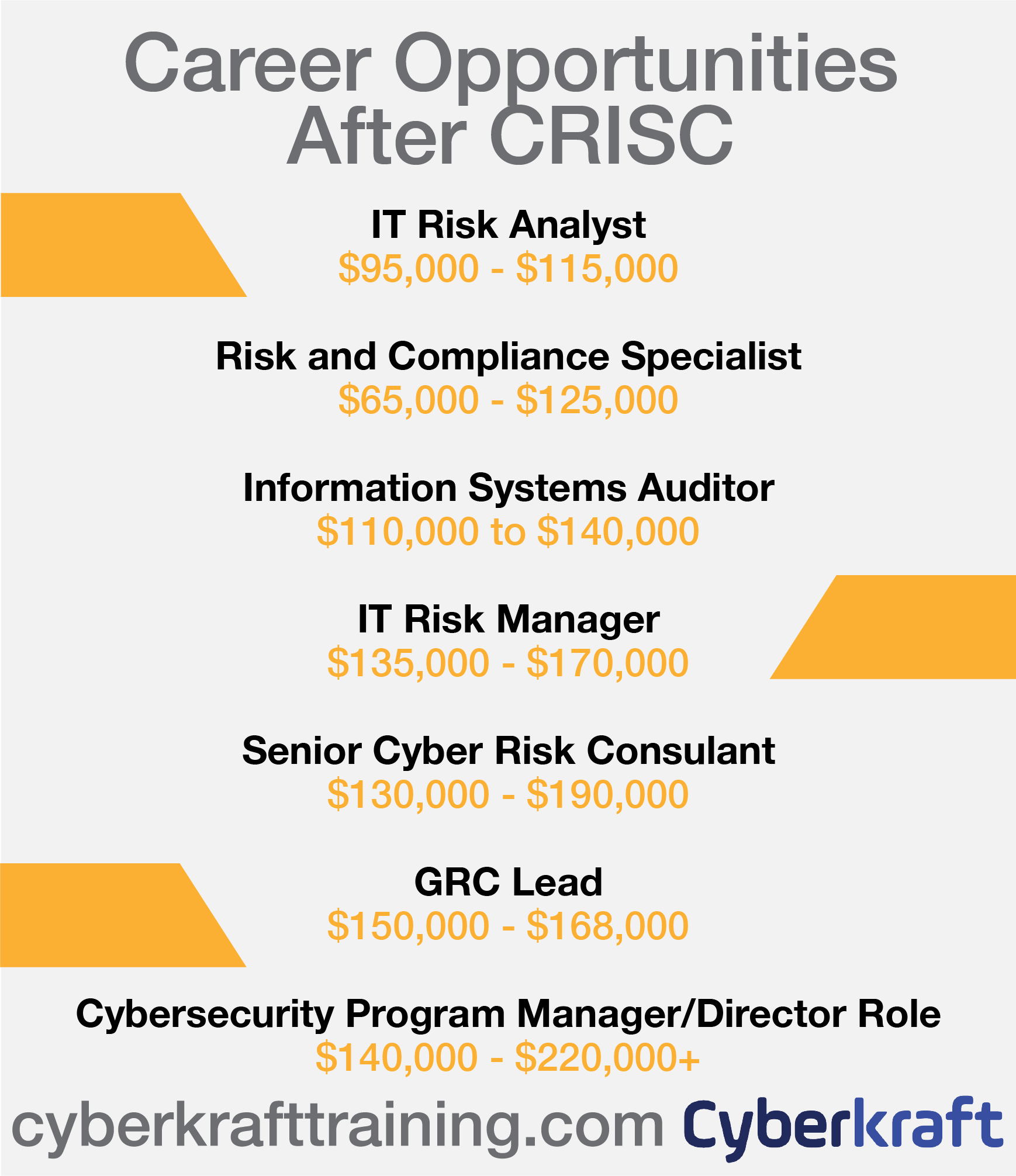
Common positions held by CRISC-certified people include IT Risk Analyst, a role in which you evaluate controls, dig into systems, and figure out what could go wrong before it does. It’s practical, foundational, and often the launchpad into governance roles. Most salaries sit somewhere between $95,000 and $115,000 a year.
From there, a natural move is into a Risk and Compliance Specialist role. It’s more focused on alignment and accountability. You’ll work with standards like ISO 27001, SOC 2, and NIST, making sure policies and documentation match reality. It’s thoughtful, detail-driven work, and typically pays around $65,000 to $125,000 per year.
Another direction people take is becoming an Information Systems Auditor. In this role, you’ll assess controls, validate processes, and help leadership identify cracks. Salaries usually range from $110,000 to $140,000 a year.
The move is into an IT Risk Manager role, where you decide what matters and what doesn’t. You’ll shape priorities, communicate with executives, and guide strategy. Most people in this role earn between $135,000 and $170,000 annually.
If you prefer a dynamic environment over the same organization’s systems, you can choose to be a Senior Cyber Risk Consultant. You’ll work with multiple clients, tackle new problems regularly, and help organizations build resilience rather than just maintain it. Compensation typically ranges from $130,000 to $190,000 per year.
If you enjoy structure, oversight, and maturity-building, the GRC Lead role is a compelling step. You’ll own frameworks, internal audits, reporting, and the long game of compliance maturity. Employers tend to appreciate CRISC here because it blends business priorities with risk decisions. Pay usually sits between $150,000 and $168,000 a year.
Eventually, with enough depth and leadership experience, some progress into a Cybersecurity Program Manager or Director role. Here, the focus is on vision, budget, influence, and outcomes. At this level, compensation can reach anywhere from $140,000 to $220,000+, depending on the company and sector.
Why CRISC Matters for Organizations
Employers who hire CRISC-certified persons gain a capable risk strategist with the right credentials. They bring a structured, enterprise-level approach to risk management and decision-making, reducing the chance of breaches, audit failures, compliance gaps, or vendor-related threats.
With the right skill set, you help the organization build policies, frameworks, and decisions that aren’t based on assumptions, urgency, or fear but grounded in real business impact. Instead of reacting to every new threat or tool on the market, you help prioritize what actually matters. You’ll also guide organizations through standards like NIST 800-53, NIST 800-37,, ISO 27001, GDPR, HIPAA, and PCI DSS with confidence and clarity.
In high-stakes sectors like finance, healthcare, energy, telecom, government, and consulting, poor cyber risk oversight is costly. One misstep can lead to fines, operational downtime, shareholder scrutiny, loss of customer trust, and, in regulated industries, additional legal penalties. And when something goes wrong, leadership looks for answers, accountability, and a plan.
Participate in Cyberkraft’s CRISC Bootcamp to be prepared to provide all three. You can justify priorities, connect decisions to business impact, and steer the organization toward the most effective and defensible response.
Even without a breach, organizations face pressure from auditors, insurers, and external partners to prove that cybersecurity decisions are based on measurable criteria rather than guesswork or personal opinion. Having a certified expert means stronger governance, clearer reporting, better readiness for audits and regulatory reviews.
Beyond compliance, they help organizations align IT and business objectives, balance cost and risk, and build trust with stakeholders, clients, and regulators. For organizations focused on maturing governance, improving resilience, or building a more strategic cybersecurity program, having CRISC-certified talent is helpful, as it provides a technical and strategic safety net, and becomes a competitive advantage.
Start Positioning Yourself for Leadership in Cyber Risk
CRISC helps you confidently make the move from being a “doer” to a “decider.” You gain frameworks, language, and tools to evaluate trade-offs, prioritize what matters, and lead discussions where budgets, operations, and security intersect. These skills alone set you apart, especially in environments where cybersecurity decisions now influence financial strategy, insurance eligibility, and compliance posture.
With the guidance and structured support offered by Cyberkraft’s CRISC course + voucher bundle, you can prepare efficiently, build confidence, and earn the CRISC credential that aligns your work with long-term leadership opportunities. If you’ve been thinking about what’s next for your career, now is the right time to act.

Responses