

Importance of the ISACA CISM Certification

Information security today goes far beyond defending networks and handling emergencies. Organizations expect their security teams to efficiently manage risk, justify investment, and align protection with business objectives. It requires technical understanding, strategic thinking, and the ability to communicate effectively with executive leadership.
Professionals in advanced technical or operational roles frequently run into a constraint. Their experience helps solve complex technical problems, but moving into managerial or strategic positions depends on demonstrating structured competence in governance, compliance, and program oversight.
The Certified Information Security Manager (CISM) certification, developed by the Information Systems Audit and Control Association (ISACA), was designed to address the issue. It validates a person’s knowledge of information security and their capacity to manage it as a business function, aligning protection, governance, and performance.
In this article, we’ll discuss ISACA’s credibility, the structure and purpose of the CISM certification, the CISM certification benefits for professionals and organizations, and why it remains a global benchmark for professionals seeking to advance from technical execution to strategic leadership in cybersecurity.
About ISACA and the CISM Certification
ISACA, founded in 1969, is a global professional association recognized for its standards and certifications in information systems governance, risk, and assurance. Its certifications, including CISM, are widely respected across audit, compliance, and cybersecurity functions.
Introduced in 2002, ISACA’s CISM certification is designed for professionals managing enterprise security programs. It evaluates a candidate’s capacity to manage risk, make well-informed decisions, and implement governance and policy frameworks rather than testing technical or configuration skills.
The certification is structured around four domains:
-
- Information Security Governance
-
- Information Risk Management
-
- Information Security Program Development and Management
-
- Incident Management.
To deepen understanding of these domains, Cyberkraft’s ISACA CISM Course offers structured guidance and practical insight while preparing for the CISM exam, helping candidates build the leadership and strategic capabilities essential for senior security positions.
CISM Certification Benefits for Professionals:
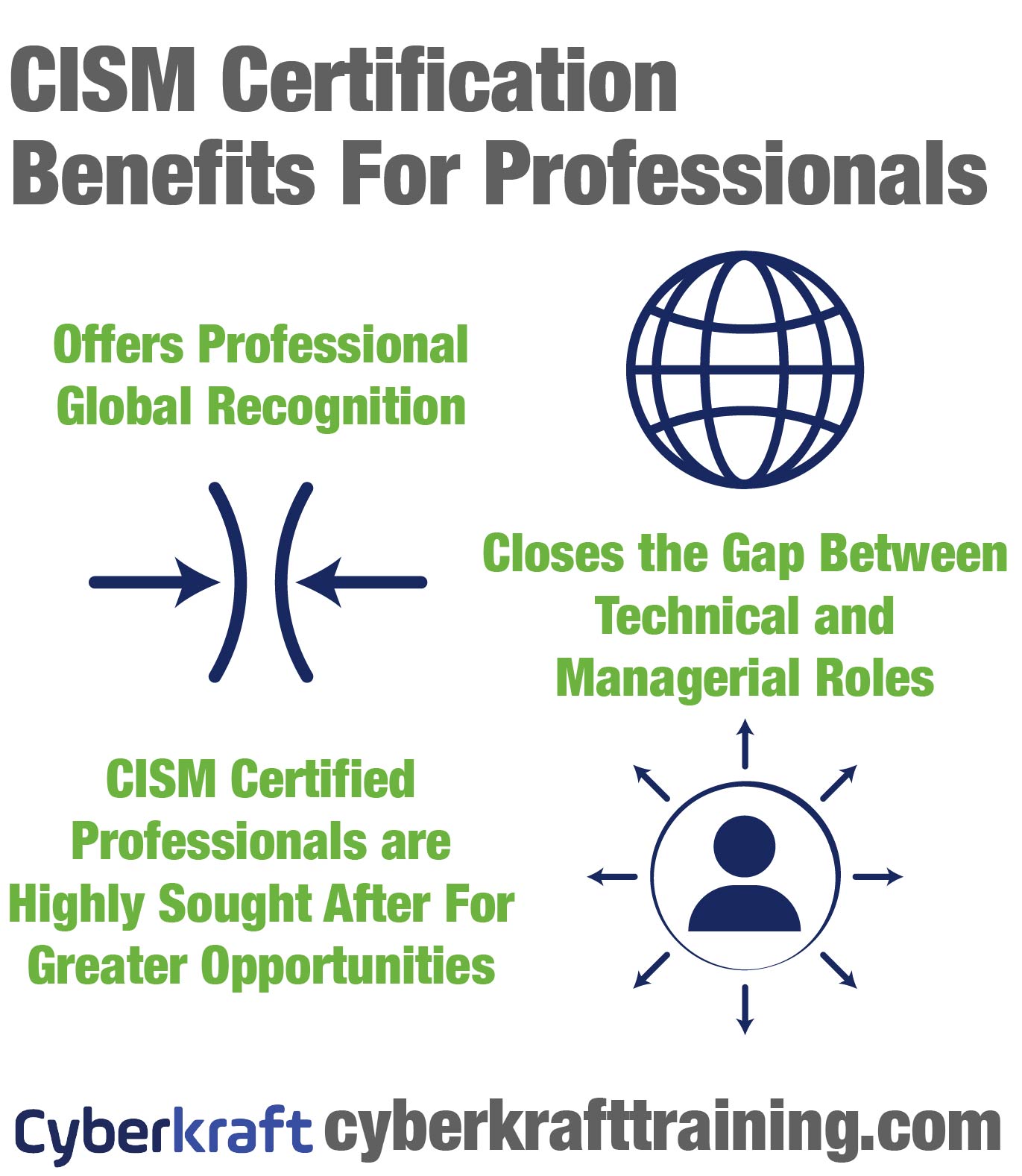
The CISM certification offers professionals global recognition and credibility, positioning them as leaders in information security governance. It signals that they can think strategically, manage risk, and align security initiatives with business goals.
It also closes the gap between technical and managerial roles, making it ideal for professionals transitioning from hands-on cybersecurity roles to leadership positions. The program equips you with frameworks and decision-making tools for executive-level responsibilities.
In terms of career advancement, CISM-certified professionals are highly sought after for managerial and governance-focused positions. They often command higher salaries, faster promotions, and access to more senior opportunities.
The certification also develops your structured understanding of enterprise security, ability to design, implement, and manage end-to-end security programs, from risk assessment to incident response.
CISM encourages ongoing professional development through its continuing professional education (CPE) requirements and ISACA’s Code of Professional Ethics. This ensures certification holders stay updated on emerging threats, governance trends, and best practices.
CISM Certification Benefits for Employers:
Hiring CISM-certified professionals help align security initiatives and business goals. Their approach ensures that security investments and policies directly support organizational objectives.
CISM-certified experts strengthen risk management and compliance by applying established standards like ISO 27001, GDPR, and NIST 800-53.
CISM holders’ knowledge in governance, risk, and incident management contributes to increased organizational resilience. By reducing vulnerabilities and strengthening response readiness, they help business withstand and recover from security disruptions more effectively
CISM-trained professionals improve communication between IT teams and leadership. They can translate complex technical issues into business terms, allowing for informed decision-making and reducing misunderstandings.
Employers further benefit from executives’ commitment to ethical and professional standards. CISM-certified individuals follow ISACA’s Code of Professional Ethics and stay current on CPE obligations, ensuring their knowledge stays current and reliable.
Why Organizations Trust CISM-Certified Professionals
Employers see the ISACA CISM certification as proof of maturity in information security management. The CISM certification indicates that a professional can manage security at the governance level rather than just executing it. CISM demonstrates knowledge of compliance frameworks, accountability systems, and the ability to turn technical results into business-relevant insights.
The certification shows competence in three areas that consistently determine the strength of a security program: governance, risk management, and communication. These are not theoretical concepts; they determine whether a company can maintain compliance, respond effectively to incidents, and communicate with regulators or boards.
Certified professionals are trained to design security programs that protect information assets, meet compliance obligations, and provide measurable assurance to leadership.
Common positions held by CISM-certified professionals include roles such as Information Security Manager, a position responsible for overseeing an organization’s information security program, aligns policies with business objectives, and ensures compliance with internal and external requirements. The average annual salary is around $140,000–150,000 USD.
Another common role is Governance, Risk, and Compliance (GRC) Lead, where the professional develops and enforces governance frameworks, manages enterprise risk assessments, and prepares reports for executive and regulatory review. Professionals in this role typically earn an average salary of $190,000–195,000 USD per year.
Many CISM-certified professionals also work as IT Auditor or Security Auditor. In these positions, they evaluate internal controls, validate compliance with standards such as ISO 27001 or NIST, and advise management on risk exposure. Salaries for these roles generally fall between $80,000–90,000 USD per year.
At the senior-most level, CISM holders may serve as Chief Information Security Officer (CISO). These executives define organizational security strategy, manage budgets, and report directly to the board or executive committee. Compensation for CISOs typically ranges from $100,000–220,000 USD annually.
For professionals who already have technical certifications like CompTIA Security+, Certified Ethical Hacker (CEH), or ISC2 CISSP, CISM certification offers a logical next step. It builds on technical foundations and signals inclination to move from implementation to oversight.
Due to its focus on management and governance, CISM certification for professionals continues to appear in job descriptions for mid- to senior-level security positions worldwide. Employers value it as tangible evidence and as a benchmark for promoting technically skilled individuals into management or governance-focused roles.
Professionals aiming for senior roles should consider Cyberkraft’s CISM Bootcamp, which emphasizes real-world application of governance, risk management, and program oversight, aligned with ISACA’s domains.
Lasting Relevance of CISM
While cybersecurity technologies change quickly, the concepts and principles that drive good governance remain constant. The CISM certification value lies in its framework that emphasizes risk management, decision-making, and communication, disciplines that remain relevant regardless of new tools or threats.
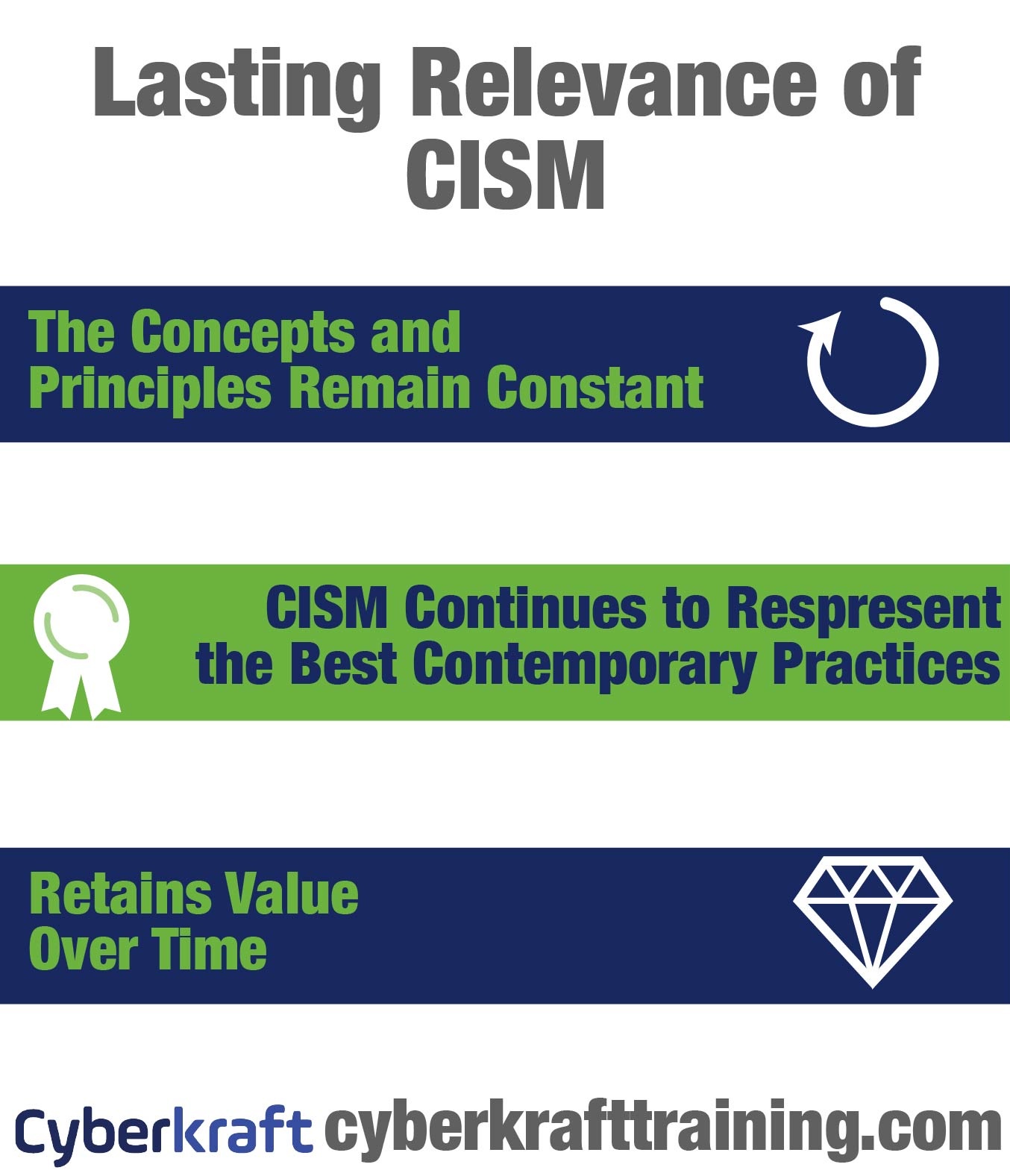
ISACA periodically updates its examination content and continuing education requirements to reflect changes in global standards and regulatory expectations. This commitment to CISM continuing professional education ensures that CISM continues to represent contemporary best practices without losing sight of its foundational purpose: building resilient, accountable security leadership.
Since it focuses on processes and governance rather than transient technologies, the CISM certification retains its value over time. Organizations see it as an assurance that the holder is equipped to lead security efforts with structure, clarity, and accountability, even as the technical part shifts.
Move Into a Management Role with ISACA CISM
Technical expertise can advance a cybersecurity career only to a point. Leadership needs a diverse set of abilities, including managing risk and business priorities, establishing governance, and communicating decisions effectively. The ISACA CISM certification validates this by certifying the individual’s ability to manage information security as a structured, strategic role rather than a technical one.
For professionals expanding beyond technical execution and evaluating whether CISM certification is worth it, the answer is clear: CISM is an indication that you understand security where it counts most — at the intersection of strategy and responsibility. It gives you the foundation to operate in positions where decisions carry organizational impact and where security is evaluated by strategy, clarity, and measurable outcomes.
If you’re planning to take the exam, Cyberkraft’s CISM Course + Voucher Bundle combines instruction with a fully paid exam voucher for one CISM exam attempt, streamlining the certification process to earning the globally respected CISM credential.
Information security today goes far beyond defending networks and handling emergencies. Organizations expect their security teams to efficiently manage risk, justify investment, and align protection with business objectives. It requires technical understanding, strategic thinking, and the ability to communicate effectively with executive leadership.
Professionals in advanced technical or operational roles frequently run into a constraint. Their experience helps solve complex technical problems, but moving into managerial or strategic positions depends on demonstrating structured competence in governance, compliance, and program oversight.
The Certified Information Security Manager (CISM) certification, developed by the Information Systems Audit and Control Association (ISACA), was designed to address the issue. It validates a person’s knowledge of information security and their capacity to manage it as a business function, aligning protection, governance, and performance.
In this article, we’ll discuss ISACA’s credibility, the structure and purpose of the CISM certification, the CISM certification benefits for professionals and organizations, and why it remains a global benchmark for professionals seeking to advance from technical execution to strategic leadership in cybersecurity.
About ISACA and the CISM Certification
ISACA, founded in 1969, is a global professional association recognized for its standards and certifications in information systems governance, risk, and assurance. Its certifications, including CISM, are widely respected across audit, compliance, and cybersecurity functions.
Introduced in 2002, ISACA’s CISM certification is designed for professionals managing enterprise security programs. It evaluates a candidate’s capacity to manage risk, make well-informed decisions, and implement governance and policy frameworks rather than testing technical or configuration skills.
The certification is structured around four domains:
-
- Information Security Governance
-
- Information Risk Management
-
- Information Security Program Development and Management
-
- Incident Management.
To deepen understanding of these domains, Cyberkraft’s ISACA CISM Course offers structured guidance and practical insight while preparing for the CISM exam, helping candidates build the leadership and strategic capabilities essential for senior security positions.
CISM Certification Benefits for Professionals:
The CISM certification offers professionals global recognition and credibility, positioning them as leaders in information security governance. It signals that they can think strategically, manage risk, and align security initiatives with business goals.
It also closes the gap between technical and managerial roles, making it ideal for professionals transitioning from hands-on cybersecurity roles to leadership positions. The program equips you with frameworks and decision-making tools for executive-level responsibilities.
In terms of career advancement, CISM-certified professionals are highly sought after for managerial and governance-focused positions. They often command higher salaries, faster promotions, and access to more senior opportunities.
The certification also develops your structured understanding of enterprise security, ability to design, implement, and manage end-to-end security programs, from risk assessment to incident response.
CISM encourages ongoing professional development through its continuing professional education (CPE) requirements and ISACA’s Code of Professional Ethics. This ensures certification holders stay updated on emerging threats, governance trends, and best practices.
CISM Certification Benefits for Employers:
Hiring CISM-certified professionals help align security initiatives and business goals. Their approach ensures that security investments and policies directly support organizational objectives.
CISM-certified experts strengthen risk management and compliance by applying established standards like ISO 27001, GDPR, and NIST 800-53.
CISM holders’ knowledge in governance, risk, and incident management contributes to increased organizational resilience. By reducing vulnerabilities and strengthening response readiness, they help business withstand and recover from security disruptions more effectively
CISM-trained professionals improve communication between IT teams and leadership. They can translate complex technical issues into business terms, allowing for informed decision-making and reducing misunderstandings.
Employers further benefit from executives’ commitment to ethical and professional standards. CISM-certified individuals follow ISACA’s Code of Professional Ethics and stay current on CPE obligations, ensuring their knowledge stays current and reliable.
Why Organizations Trust CISM-Certified Professionals
Employers see the ISACA CISM certification as proof of maturity in information security management. The CISM certification indicates that a professional can manage security at the governance level rather than just executing it. CISM demonstrates knowledge of compliance frameworks, accountability systems, and the ability to turn technical results into business-relevant insights.
The certification shows competence in three areas that consistently determine the strength of a security program: governance, risk management, and communication. These are not theoretical concepts; they determine whether a company can maintain compliance, respond effectively to incidents, and communicate with regulators or boards.
Certified professionals are trained to design security programs that protect information assets, meet compliance obligations, and provide measurable assurance to leadership.
Common positions held by CISM-certified professionals include roles such as Information Security Manager, a position responsible for overseeing an organization’s information security program, aligns policies with business objectives, and ensures compliance with internal and external requirements. The average annual salary is around $140,000–150,000 USD.
Another common role is Governance, Risk, and Compliance (GRC) Lead, where the professional develops and enforces governance frameworks, manages enterprise risk assessments, and prepares reports for executive and regulatory review. Professionals in this role typically earn an average salary of $190,000–195,000 USD per year.
Many CISM-certified professionals also work as IT Auditor or Security Auditor. In these positions, they evaluate internal controls, validate compliance with standards such as ISO 27001 or NIST, and advise management on risk exposure. Salaries for these roles generally fall between $80,000–90,000 USD per year.
At the senior-most level, CISM holders may serve as Chief Information Security Officer (CISO). These executives define organizational security strategy, manage budgets, and report directly to the board or executive committee. Compensation for CISOs typically ranges from $100,000–220,000 USD annually.
For professionals who already have technical certifications like CompTIA Security+, Certified Ethical Hacker (CEH), or ISC2 CISSP, CISM certification offers a logical next step. It builds on technical foundations and signals inclination to move from implementation to oversight.
Due to its focus on management and governance, CISM certification for professionals continues to appear in job descriptions for mid- to senior-level security positions worldwide. Employers value it as tangible evidence and as a benchmark for promoting technically skilled individuals into management or governance-focused roles.
Professionals aiming for senior roles should consider Cyberkraft’s CISM Bootcamp, which emphasizes real-world application of governance, risk management, and program oversight, aligned with ISACA’s domains.
Lasting Relevance of CISM
While cybersecurity technologies change quickly, the concepts and principles that drive good governance remain constant. The CISM certification value lies in its framework that emphasizes risk management, decision-making, and communication, disciplines that remain relevant regardless of new tools or threats.
ISACA periodically updates its examination content and continuing education requirements to reflect changes in global standards and regulatory expectations. This commitment to CISM continuing professional education ensures that CISM continues to represent contemporary best practices without losing sight of its foundational purpose: building resilient, accountable security leadership.
Since it focuses on processes and governance rather than transient technologies, the CISM certification retains its value over time. Organizations see it as an assurance that the holder is equipped to lead security efforts with structure, clarity, and accountability, even as the technical part shifts.
Move Into a Management Role with ISACA CISM
Technical expertise can advance a cybersecurity career only to a point. Leadership needs a diverse set of abilities, including managing risk and business priorities, establishing governance, and communicating decisions effectively. The ISACA CISM certification validates this by certifying the individual’s ability to manage information security as a structured, strategic role rather than a technical one.
For professionals expanding beyond technical execution and evaluating whether CISM certification is worth it, the answer is clear: CISM is an indication that you understand security where it counts most — at the intersection of strategy and responsibility. It gives you the foundation to operate in positions where decisions carry organizational impact and where security is evaluated by strategy, clarity, and measurable outcomes.
If you’re planning to take the exam, Cyberkraft’s CISM Course + Voucher Bundle combines instruction with a fully paid exam voucher for one CISM exam attempt, streamlining the certification process to earning the globally respected CISM credential.

Responses